EKO Matrix Explanation Guide™
A Companion to the Ekomananda Self-Knowledge & Consciousness Orientation Assessment™
Know Where You Are. Understand What Is Calling for Attention.
Heal · Awaken · Evolve

Understanding the Four Areas of the EKO Matrix
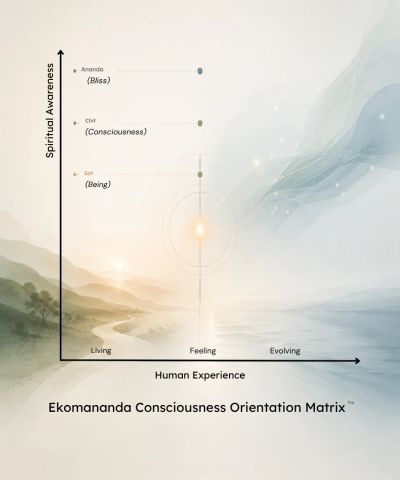
The Four Quadrants
Your position on the EKO Matrix is determined by the relationship between your Human Experience and Spiritual Awareness scores.
The four broad areas are not identities or diagnoses.
They help reveal the relationship between awareness and lived integration.
Quadrant 1 - Lower Human Experience + Emerging Spiritual Awareness
Attention may currently be centred around everyday stability, safety, emotional wellbeing, relationships, identity or physical experience.
The priority may be less about seeking extraordinary states and more about establishing greater human stability and integration.
Quadrant 2 - Stronger Human Experience + Emerging Spiritual Awareness
A person may function effectively in everyday life while relating to existence primarily through practical, rational, conventional or achievement-oriented frameworks.
Life may be stable and productive without spirituality being particularly central.
The invitation may simply be curiosity rather than change.
Quadrant 3 - Lower Human Experience + Expanded Spiritual Awareness
This is an especially important area within the EKO Framework.
A person may have significant spiritual insight or direct experience while still struggling within the human experience.
For example:
“I know I am not my thoughts, but my thoughts still overwhelm me.”
“I experience Oneness, but my relationships remain painful.”
“I understand consciousness, but my body is exhausted.”
“I have awakened spiritually, but I don't know how to live anymore.”
This does not invalidate the spiritual experience.
It suggests that awareness and human integration are not presently moving together.
The invitation may be embodiment.
Quadrant 4 - Stronger Human Experience + Expanded Spiritual Awareness
Spiritual awareness and everyday human experience appear more congruent.
Insight may increasingly be reflected through:
- emotional regulation;
- relationships;
- embodiment;
- self-worth;
- daily functioning;
- physical wellbeing;
- trust;
- presence.
This does not mean life becomes perfect.
Nor does it mean there is nothing left to discover.
It simply suggests greater congruence between awareness and lived experience across the areas measured by the assessment.
Other Aspects

Physical Experiences
Physical Wellbeing is an important part of Human Experience and is also shown separately in your profile as a supporting measure.
It provides additional context about how your present experience may be reflected through the body.
The measure may include areas such as:
- energy and vitality;
- rest and recovery;
- physical symptoms;
- body awareness;
- responsiveness to bodily needs;
- lifestyle and self-care.
A lower Physical Wellbeing score does not automatically indicate lower Spiritual Awareness.
Likewise, a high Spiritual Awareness score does not guarantee physical wellbeing.
This distinction is important.
A person may have profound spiritual awareness while living with significant physical limitation.
The Physical Wellbeing measure therefore helps us understand the relationship between awareness and embodied human experience rather than using physical health to determine spiritual orientation.
Congruence — One of the Most Important EKO Insights
The EKO Matrix becomes particularly useful when we look beyond individual scores and examine their relationship.
For example:
High Spiritual Awareness + Lower Human Experience
This may suggest:
Awareness has expanded further than aspects of the human experience have integrated.
Strong Human Experience + Emerging Spiritual Awareness
This may suggest:
Life is functioning effectively without spirituality or consciousness being central to the person's present orientation.
Strong Human Experience + Strong Spiritual Awareness
This may suggest:
Greater congruence between inner awareness and lived experience.
Congruence does not mean perfection.
It means that what is recognised inwardly is increasingly reflected through the way life is actually lived.
Your Human Experience Domains
Your overall Human Experience score is only part of the picture.
The individual domain scores help reveal where your experience is strong and where greater attention may be useful.
Do not interpret a lower domain as failure.
Instead ask:
What is this part of my experience showing me?
A profile may be uneven.
For example, someone may have:
- strong relationships but low self-worth;
- strong embodiment but difficulty trusting life;
- high emotional awareness but low physical wellbeing;
- strong safety and stability but difficulty with connection.
This unevenness is normal.
The domain profile allows the overall Human Experience score to be understood with greater nuance.
Response Clarity
Your profile may also include a Response Clarity indicator.
This considers factors such as:
- confidence in your answers;
- readiness;
- response consistency;
- use of neutral answers;
- response patterns;
- completion behaviour.
Response Clarity does not measure consciousness.
It does not change your Human Experience score.
It does not change your Spiritual Awareness score.
And it is not a judgement about you.
It simply helps indicate how confidently your responses can be interpreted as representing your present experience.
Your Matrix Position is Not Your Identity
Perhaps the most important thing to remember is this:
The map is not you.
Your scores are measurements generated from your responses to a particular set of questions at a particular moment.
Human beings are more complex than any assessment.
Your EKO Matrix position may change.
Your Human Experience may change.
Your Spiritual Awareness may change.
A profound event may alter your orientation rapidly.
Life circumstances may temporarily affect your Human Experience.
Integration may unfold over months or years.
Nothing on the matrix needs to become another identity..
Where Do I Need Work On?
The EKO Framework does not assume that everyone needs to move upward or to the right.
Instead, ask three questions:
1. Where am I now?
Look at your overall EKO Matrix position without judgement.
2. Where is there incongruence?
Compare:
- your Human Experience;
- your Spiritual Awareness;
- your Physical Wellbeing;
- your individual Human Experience domains.
Notice where your lived experience may not yet reflect what you understand or recognise inwardly.
3. What is asking for attention?
Rather than asking:
“How do I get a higher score?”
consider asking:
“What part of my present experience is asking to be seen, understood, healed or integrated?”
That is a much more useful application of the EKO Matrix.
Heal · Awaken · Evolve
The EKO Framework can be understood through three interconnected movements.
Heal
Attend to what remains unresolved within the human experience.
This may include emotional patterns, bodily experience, relationships, identity, self-worth, safety or other areas of lived experience.
Awaken
Explore the deeper nature of self, consciousness and existence.
Awakening may arise through enquiry, direct experience, spiritual practice or spontaneously through life itself.
Evolve
Allow insight to become lived experience.
Evolution in this context does not mean becoming spiritually superior.
It means allowing understanding and awareness to become increasingly congruent with the way life is actually lived.
What Happens Next?
Your EKO Matrix Profile is intended to begin enquiry, not end it.
You may wish to spend some time simply observing your results.
Notice:
- what resonates;
- what surprises you;
- what you disagree with;
- where there appears to be tension;
- which Human Experience domains attract your attention;
- whether your lived experience reflects your spiritual understanding.
You do not need to accept every interpretation.
Your direct experience remains important.
If you would like to explore your profile more deeply, you may book a Complimentary EKO Assessment Consultation.
During the consultation, a practitioner can explore your profile with you, including:
- your EKO Matrix position;
- your Human Experience domains;
- your Spiritual Awareness orientation;
- Physical Wellbeing as a supporting measure;
- areas of apparent congruence or incongruence;
- what may currently be asking for attention.
Personalised guidance is provided through conversation rather than automatically generated from an assessment score.
A Final Reflection
The EKO Matrix is not asking:
“How spiritually advanced are you?”
Nor is it asking:
“How successful are you at being human?”
It is asking something much more useful:
Where are you now?
How are you experiencing being human?
From what orientation are you meeting consciousness and life?
And is what you know inwardly being lived outwardly?
Sometimes healing is what is calling.
Sometimes awakening.
Sometimes integration.
And sometimes there is nothing to fix at all—only something to see more clearly.
Know where you are.
See what is asking for attention.
Heal · Awaken · Evolve.